Senior Living Roofing in Garland, TX

Senior Living Roofing in Garland, TX

Senior Living Roofing

Property Types We Roof

For a residential-care building, a roof inquiry needs a defined work area and a practical account of the interior space below it. We examine the covering, transitions, penetrations and drainage, then compare roof-level evidence with the reported interior condition. That helps determine whether the work is a contained flashing repair or whether wet or unstable construction extends farther. The owner can review temporary protection, the permanent correction and any access or room preparation needed before removal begins.

Garland’s municipal senior-service destinations include the Carver and Senior Activity centers. For a residential senior-living project, identify the property, affected rooms and building representative who can direct protection and roof access. Keep resident and staff identifiers off roof-zone maps, and tie photos to a building-specific label so the repair record remains useful to facilities staff. Before removal, agree on protected entrances, quiet periods, lift locations and the route for notifying affected departments. Close each shift with a weather-tight boundary and a named contact for any temporary protection.

The Garland Medical District has planned streetscape improvements and a future hospital site; Downtown Garland is another reinvestment area. For a senior-living building near either district, keep resident protection, roof-zone labels, and the property's authorized access plan specific to that facility.

Which rooms and routes may be affected?

Identify the interior area under the reported roof concern and the route needed to reach the work. A stain may point toward a search area, but water can travel before it appears inside. Compare the report with seams, curbs, wall transitions and drains above, and explain what the examination confirms. If an opening is needed, agree on its location and size, how the interior will be protected and where material may be staged before removal starts.

The building contact directs room access, resident notifications, escorts and restrictions for that property. We can describe the roofing task and the expected work boundary, then coordinate within the instructions supplied by the owner. Avoid assuming quiet hours, care routines or clinical arrangements. For work above a sensitive area, a smaller staged opening may be considered if the assembly condition permits it, but the repair must still reach sound material and receive a durable tie-in.

Senior Living Roofing in Garland, TX

What condition lies beneath the visible roof surface?

Existing coverings, repairs and transitions can vary from one building to another. Verify the membrane or roof material, attachment and visible layers rather than choosing a repair from the property label. Check whether insulation or cover board is wet, crushed or otherwise unsuitable to receive new material. If the prepared edge exposes additional damage, stop and show the owner the expanded condition before proceeding. Covering compromised construction can leave the original water path or instability unresolved.

A targeted repair should state what failed and how new material will tie into the remaining assembly. If the findings point to broader renewal, apartment roofing presents a related multi-occupied-building concern, while the actual senior-living property's construction still controls the scope. Occupied-building reroofing can be planned in stages with owner-directed preparation; compare it with hospital roof work only for general occupied-building staging, but it does not replace the need to verify access, room impacts and material compatibility before each opening.

Senior Living Roofing in Garland, TX

How will equipment and water details be returned to service?

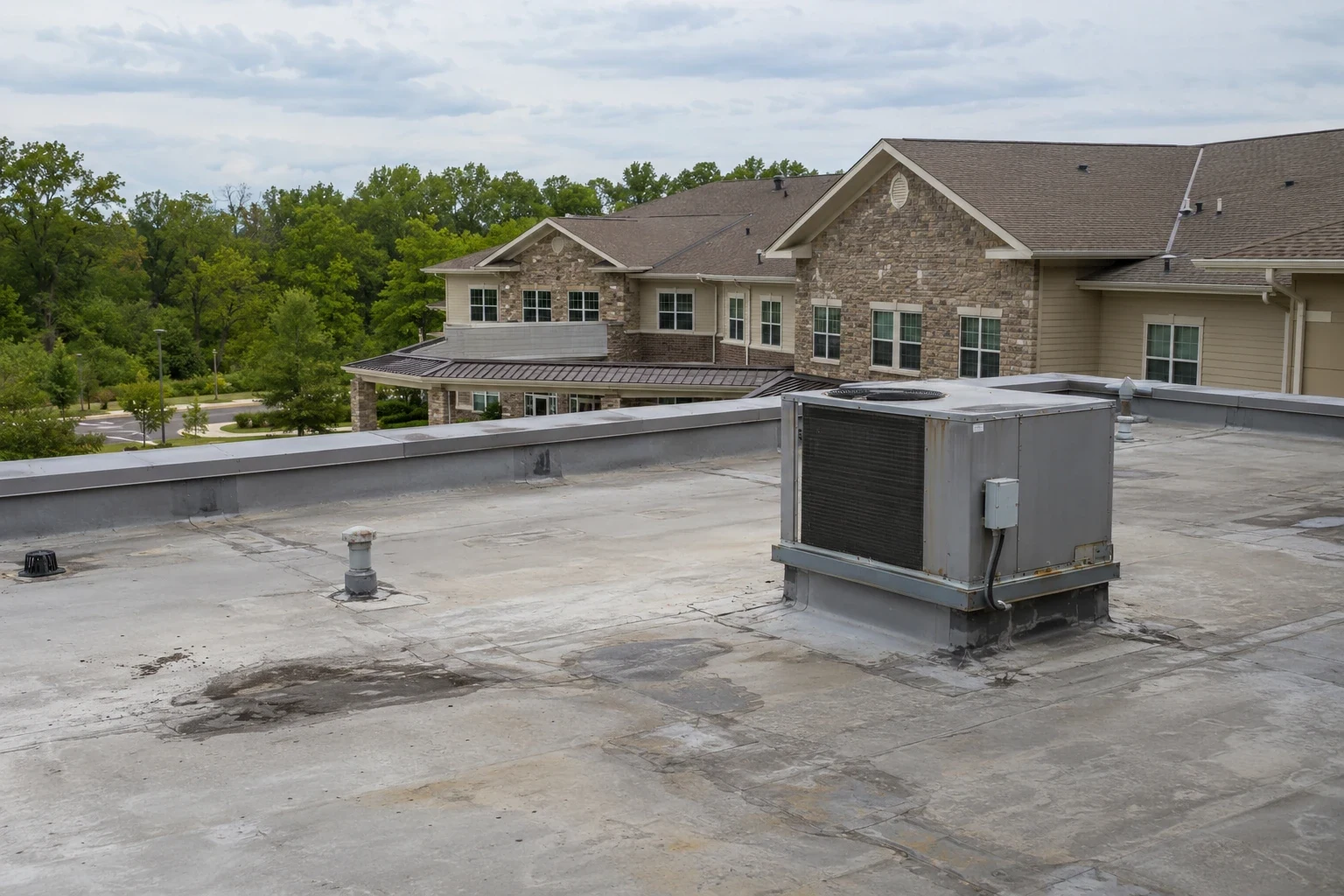
Roof-mounted mechanical equipment, exhausts, plumbing vents and drainage points create separate interfaces. Inspect flashing, curb faces, terminations and the surface around drains. If another contractor must disconnect or ready equipment, identify the component and the required return condition. Roofing work should not be represented as a repair to mechanical or plumbing systems. The owner's representative confirms who can release the component and when the permanent flashing may be installed.

At a drain, check both the connection and the surrounding membrane. A roofing repair may restore the roof interface, while downstream plumbing remains outside the roofing scope unless included separately. For reported storm impact, emergency roof repair can describe temporary exposure control while a permanent detail is evaluated. A temporary measure has a limit and should not be confused with completed reconstruction. The closeout should say what was sealed, what remains, and whether a return visit is needed.

How can work remain understandable to the owner?

Garland has public senior centers at Carver and the Senior Activity Center. At a residential-care property, coordinate roof access, resident protection and quiet-work periods with the facility’s own operator. A request near Carver Senior Center still needs the correct property address. For a larger building, roof condition reporting can attach photographs and follow-up items to the inspected roof area. Record the material removed or retained, the completed tie-in, and any component that another trade had to prepare. If temporary protection remains, state its location, inspection limit and the permanent task still due. List interior finish work separately from roofing so the owner can tell which portion of the reported damage remains unresolved. Before approving an added opening, show the exposed condition, explain why the original boundary no longer fits and describe how the revised area will be secured. The building representative can then approve the actual change and arrange any required room preparation. Closeout should leave a clear record of the roof condition observed, what was repaired and what follow-up is still needed. If the affected area sits above a resident room, corridor or common space, record only the location and access details authorized by the building contact. Do not include resident names or care information in a roof report unless the owner specifically requires and authorizes that record. The property contact can also confirm who accepts the repaired detail, who receives notice of a temporary cover and which interior restoration remains assigned elsewhere. These responsibilities matter when the roof is ready before the interior is restored, or when another contractor must first release a curb or drain connection.

For an occupied care property, temporary protection must account for the route below the roof work, not only the opening itself. The building representative can identify rooms or circulation paths that require protection and coordinate any ceiling access. Use roof-zone labels rather than resident names on the plan or photo log. If a repair requires noise, odor, or a mechanical shutdown, confirm the affected area and responsible facility contact before material is applied. At handoff, describe the completed connection and any remaining interior follow-up without implying that a roofing repair resolves a separate building-service issue.

Before the crew leaves, the facilities lead should know whether the roof is fully closed, under temporary cover, or waiting on another trade. That simple status prevents a protected opening from being mistaken for a completed repair.

Senior Living Roofing in Garland, TX

Common Questions

Do you work around residents or care operations?

The building contact directs access, notices, room preparation and any site rules. The roofing scope should identify the work boundary and material task so the owner can arrange those needs for the specific property.

Can you identify nearby senior-living facilities from the city directory?

Residential-care roofs need an access and interior-protection plan based on the facility’s building and operating schedule. A project location should be confirmed by the owner or property records before describing it as senior living.

Can a temporary patch serve as the final repair?

Only when the examined condition supports a permanent repair using compatible materials and sound substrate. Temporary protection should have a stated limit; wet or deteriorated layers may require removal and reconstruction.

What should the owner receive at closeout?

A clear note of the inspected location, observed layers, repair boundary, materials installed, photographs and remaining items. If equipment readiness or access prevented completion, document the required condition for a return visit.

Senior Living Roofing in Garland, TX

Review an occupied-care roof concern

Share the property address, reported roof condition and designated building contact. We can examine the assembly, define the repair boundary and coordinate the proposed roofing work with owner-provided access and interior preparation directions.

Call 555-555-5555 or request a roof assessment.

Questions About Your Roof?

ServicesRoof SystemsProperty TypesIndustriesService AreasDamage RepairCapabilitiesManufacturersAboutRequest a Roof Assessment555-555-5555
Call us today555-555-5555